Software Development
Fixed Price vs Time and Materials vs Dedicated Team: Which Contract Fits?
Fixed price, time and materials or a dedicated team? How each software development contract model handles scope, risk, budget and control, and how to pick the right one.
In shortChoose fixed price when the scope is small and genuinely settled, time and materials when you expect requirements to change as you learn, and a dedicated team when you need ongoing development capacity for months or years. Most products start with a fixed-price discovery phase, then move to time and materials or a dedicated team for the build.
The contract model shapes the whole project more than people expect. It decides who carries the risk when an estimate is wrong, how easily you can change your mind, and how much the vendor is rewarded for speed versus quality. Pick the wrong one and you’ll argue about change requests instead of building software.
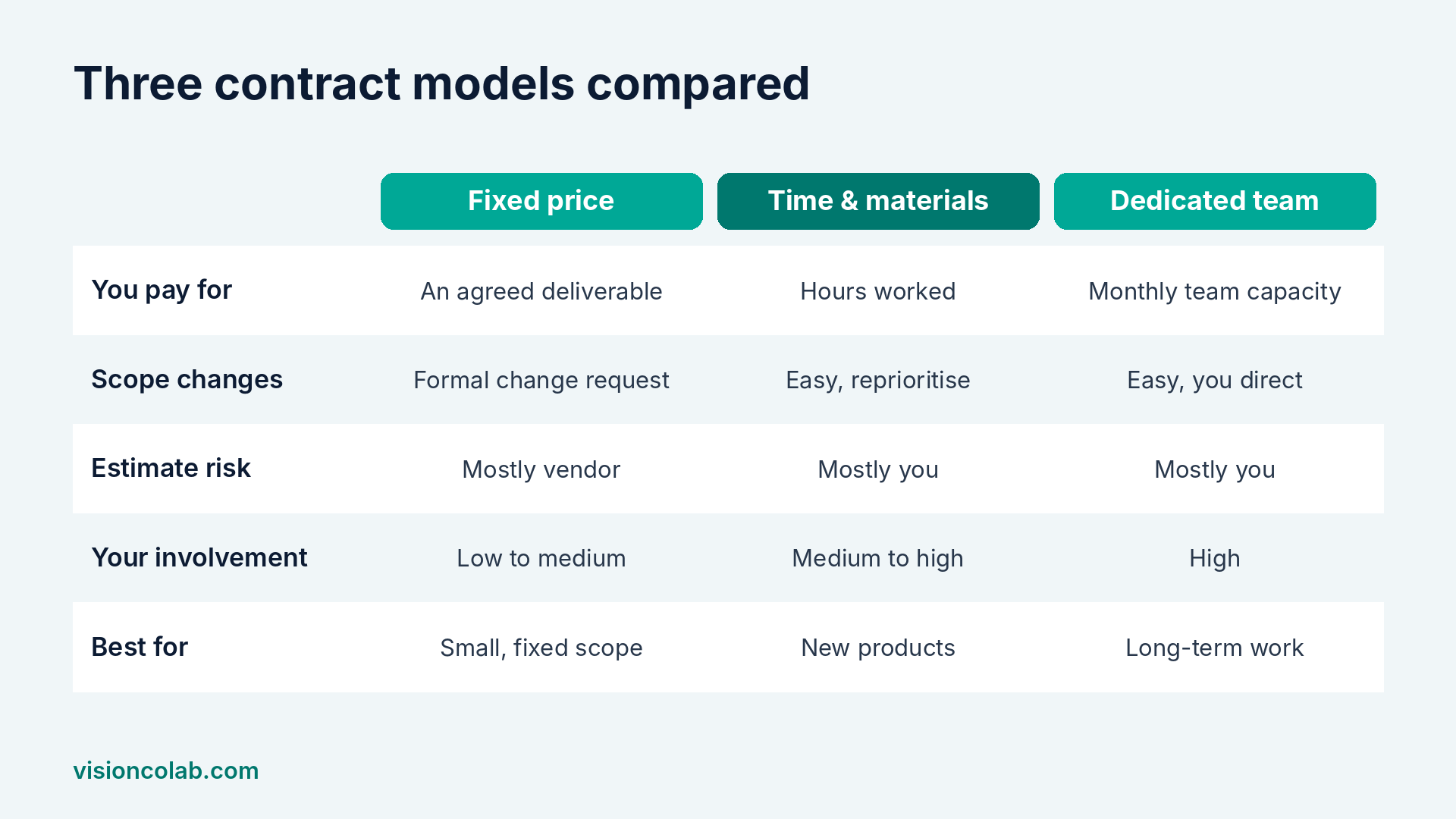
The three models at a glance
| Fixed price | Time and materials | Dedicated team | |
|---|---|---|---|
| You pay for | An agreed deliverable | Hours actually worked | A team’s monthly capacity |
| Scope changes | Need a formal change request | Easy, reprioritise the backlog | Easy, you direct the work |
| Who carries estimate risk | Mostly the vendor | Mostly you | Mostly you |
| Budget predictability | High, if scope holds | Medium, managed by caps | High per month |
| Your involvement | Low to medium | Medium to high | High |
| Best for | Small, well-defined jobs | New products, evolving scope | Long-term product work |
Fixed price: predictable, until it isn’t
Fixed price feels safest to buyers because the number is agreed in advance. It works well for a landing page, a defined integration, a migration with a clear inventory, or a discovery phase with fixed outputs.
The catch is that the vendor is taking a risk, and they price it in. Expect a buffer of 20 to 40 percent on top of their honest estimate. Every unclear requirement becomes a negotiation, because anything not written down is “out of scope”. And when time gets tight, the easiest thing to cut is quality nobody specified: tests, documentation, edge cases.
Fixed price is a good fit when you can write down exactly what “done” looks like and you’re confident it won’t change. For a new product, that’s rarely true.
Time and materials: flexible, if you stay involved
With time and materials (T&M) you pay for the hours worked at agreed rates. You can change priorities every sprint, drop features that testing shows nobody wants, and add the ones they do. There’s no padding for risk, so the hourly cost of the work is usually lower than in a fixed bid.
The risk moves to you, so you need visibility. Insist on:
- A monthly budget cap that can’t be exceeded without your written approval.
- Weekly timesheets broken down by task.
- Working software demonstrated at the end of each sprint.
- A burn-up chart showing scope, done work and remaining budget.
T&M works best when someone on your side can make product decisions quickly. If nobody owns the backlog, hours drift.
Dedicated team: an extension of your company
Here you hire a stable team, for example two developers, a QA engineer and a part-time designer, for a fixed monthly fee. They work only on your product, learn your domain and join your rituals. You decide what they build.
This is the most efficient model for long-running work because knowledge stays in the team. It’s the least efficient if you don’t have enough work to keep them busy, or nobody to lead them. A dedicated team without a product owner is an expensive way to wait.
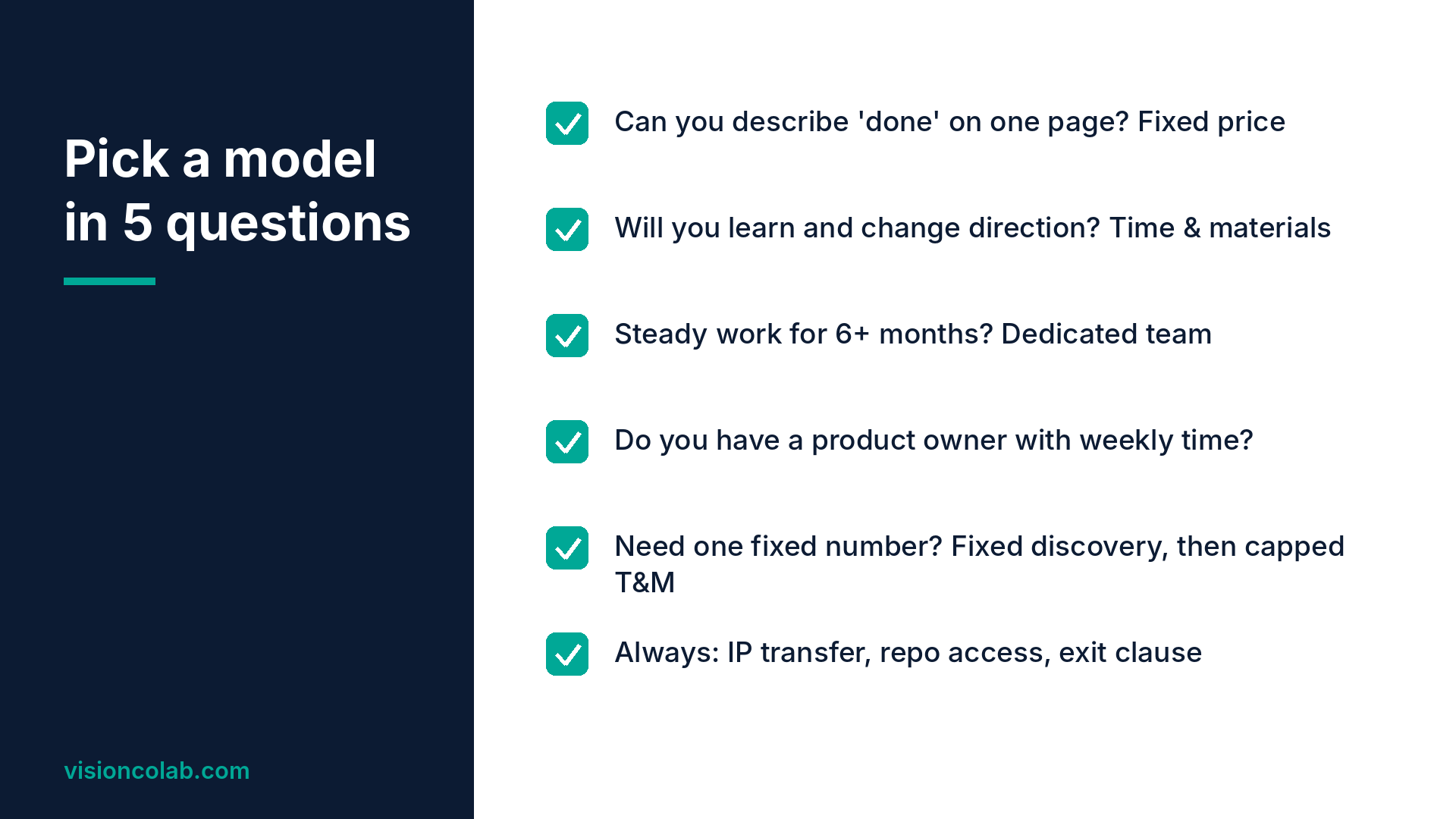
How to choose in five questions
- Can you describe “done” in a page, and will it stay that way? Yes points to fixed price.
- Do you expect to learn from users and change direction? Yes points to T&M.
- Will there be steady work for six months or more? Yes points to a dedicated team.
- Do you have a product owner with time each week? T&M and dedicated teams need one.
- Does finance need a single fixed number? Use fixed price for discovery, then a capped T&M budget.
The hybrid most of our clients end up with
In practice, the pattern that works best is staged. A fixed-price discovery of two to four weeks produces requirements, designs and an estimate. The build then runs on T&M with a monthly cap, or with a fixed price per milestone where scope is firm. After launch, a smaller dedicated team handles improvements and maintenance. Each stage uses the model that fits how much you know at that point.
Contract clauses to check whichever model you pick
- Intellectual property transfers to you on payment.
- You have access to the code repository from day one.
- A warranty period for defects after delivery.
- A reasonable notice period to exit, with a handover obligation.
- Named key people, and how replacements are handled.
Frequently asked questions
Is fixed price cheaper than time and materials?
Not usually. Fixed bids include a risk buffer, and change requests add more. T&M is often cheaper overall when scope changes, as long as someone manages the budget actively.
Can we switch models mid-project?
Yes, and it’s common. Switching at a natural milestone, such as after discovery or after launch, is far easier than switching in the middle of a sprint.
How does this affect cost estimates?
See our custom software development cost guide for how estimates are built and what drives them up.
Further reading
Not sure which model fits your project?
VisionColab offers all three and will tell you honestly which one suits your stage. See our custom software development services or book a free consultation.
Written by the VisionColab team
VisionColab designs and builds AI, web, mobile and cloud software for businesses. Our guides explain the decisions, costs and trade-offs involved in planning a software project.