Mobile App Development
How Much Does Mobile App Development Cost?
The factors that decide what a mobile app costs to build and run, how to read a quote, and how to reduce cost without cutting what matters.

In shortMobile app cost is set mainly by six things: features, platforms, the backend, design, integrations, and security requirements. Budget for hosting, updates and store fees after launch too. For most new products, a cross-platform MVP with a clearly limited feature list is the cheapest way to start.
Ask ten agencies what an app costs and you will get ten very different answers. That is not because some are dishonest. It is because “an app” can mean a simple booking tool or a marketplace with payments, chat and real-time tracking. The cost follows the features, the platforms and the systems behind the app.
This guide explains what drives the price, what you will keep paying after launch, and how to get a quote you can trust.
The six biggest cost drivers
1. Features and complexity
Each feature needs screens, logic, data storage and testing. Some features are far more expensive than they look: real-time chat, live location tracking, video, offline mode, payments and anything involving AI.
2. Platforms
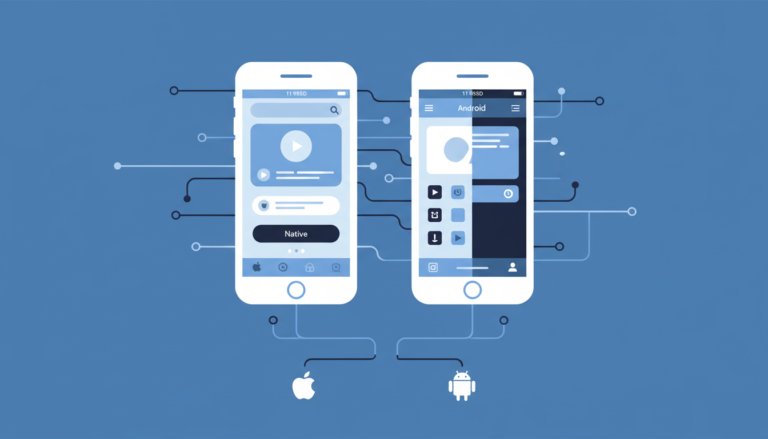
Building separate native apps for iOS and Android roughly doubles the app-side work. Cross-platform frameworks such as Flutter and React Native let one codebase serve both, which usually lowers cost for most business apps. Apps that rely heavily on device hardware or platform-specific features may still benefit from native development.
3. The backend
Most apps need a server: user accounts, a database, business rules, notifications and an admin panel for your staff. The backend is often as much work as the app itself, and it is the part buyers forget to budget for.
4. Design
A standard interface using platform conventions is quicker to design and build than a fully custom look with animations. Good UX research before building reduces rework later.
5. Integrations
Payment gateways, maps, CRMs, ERPs, booking systems and identity providers each add work. A well-documented API connects quickly; an older internal system may not.
6. Security and compliance
Apps handling health, financial or children’s data need stronger security, audit trails and legal review. That work is necessary, not optional.
How complexity changes the effort
| App type | Typical features | Relative effort |
|---|---|---|
| Simple | Login, a few content screens, forms, notifications | Low |
| Medium | User profiles, payments, admin panel, integrations, search | Medium |
| Complex | Marketplace, real-time chat or tracking, multiple user roles, AI features, offline sync | High |
Hourly rates vary widely by country and by agency, so the same scope can be priced very differently. Compare quotes on the scope and the team, not only on the total.
Costs after launch
- Hosting and services: servers, databases, file storage, email and SMS providers, maps and other APIs.
- App store accounts: Apple charges an annual developer fee and Google a one-time registration fee. Both stores also take a share of in-app digital sales.
- Maintenance: every new iOS and Android version can require updates. Libraries need security patches.
- Improvements: real users will ask for changes. Budget for ongoing development, not just a launch.
How to reduce cost without cutting quality
- Start with an MVP. Build the one workflow users need most, launch, and learn.
- Use cross-platform development unless you have a clear reason not to.
- Use proven services for login, payments and notifications instead of building them.
- Design before you build. Clickable prototypes are much cheaper to change than code.
- Consider a web app first if users do not need device features or app store presence.
How to read a quote
A trustworthy quote lists features, platforms, backend work, design, testing and deployment separately. Check that it states who owns the code, what support is included after launch, and how changes to scope are handled. A very low quote often leaves out the backend, testing or app store submission.
Frequently asked questions
Is it cheaper to build for iOS or Android first?
Choose the platform your target users actually use. With a cross-platform framework, launching on both often costs only modestly more than one.
Can I get a fixed price?
Yes, for a clearly defined scope. If the scope is still evolving, a time-and-materials or phased approach usually costs less overall.
How long does it take?
Timeline follows scope in the same way cost does. An MVP is much faster than a full product, and a discovery phase gives a realistic schedule.
Get an estimate for your app
VisionColab designs and builds mobile apps for iOS and Android. See our mobile app development services, explore UI/UX design, or book a free consultation for a scoped estimate.
Written by the VisionColab team
VisionColab designs and builds AI, web, mobile and cloud software for businesses. Our guides explain the decisions, costs and trade-offs involved in planning a software project.