Artificial Intelligence
How to Choose an AI Development Company: 12 Questions to Ask
Twelve questions to ask an AI development company before you sign: proof of production work, data readiness, ownership, model choice, running costs, security, monitoring and handover.
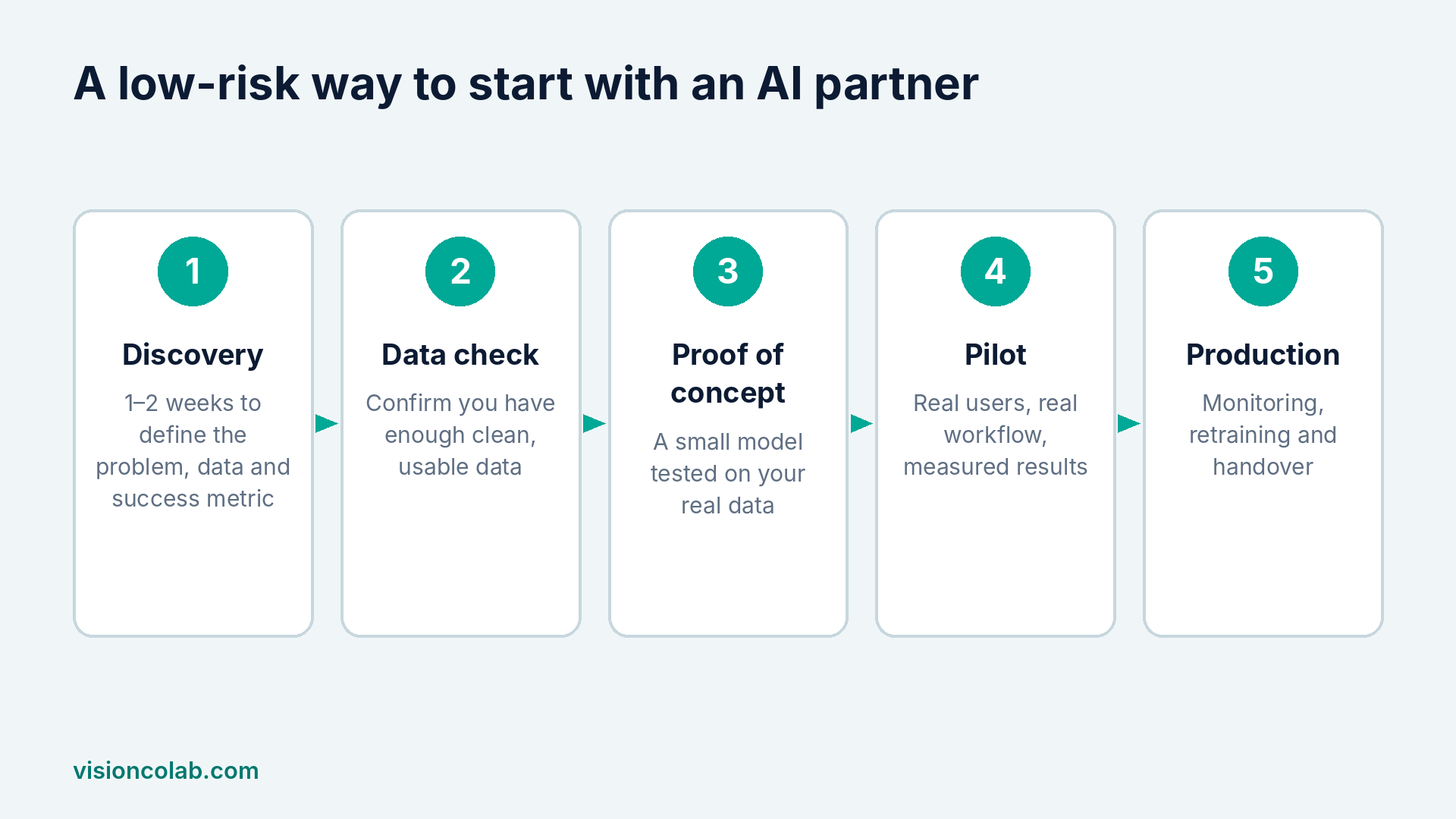
In shortPick an AI development company that can show you a similar system running in production, insists on checking your data before promising results, agrees on a measurable success metric up front, gives you ownership of the code and trained models, and quotes the monthly running cost as well as the build cost. The safest way to start is a small paid discovery phase, not a big fixed contract.
We sit on the vendor side of this conversation every week, so we’ve heard what good buyers ask and what they forget. The forgotten questions are almost always the expensive ones. A polished demo tells you a team can build a demo. It tells you very little about whether they can ship something that still works six months later on messy, real data.
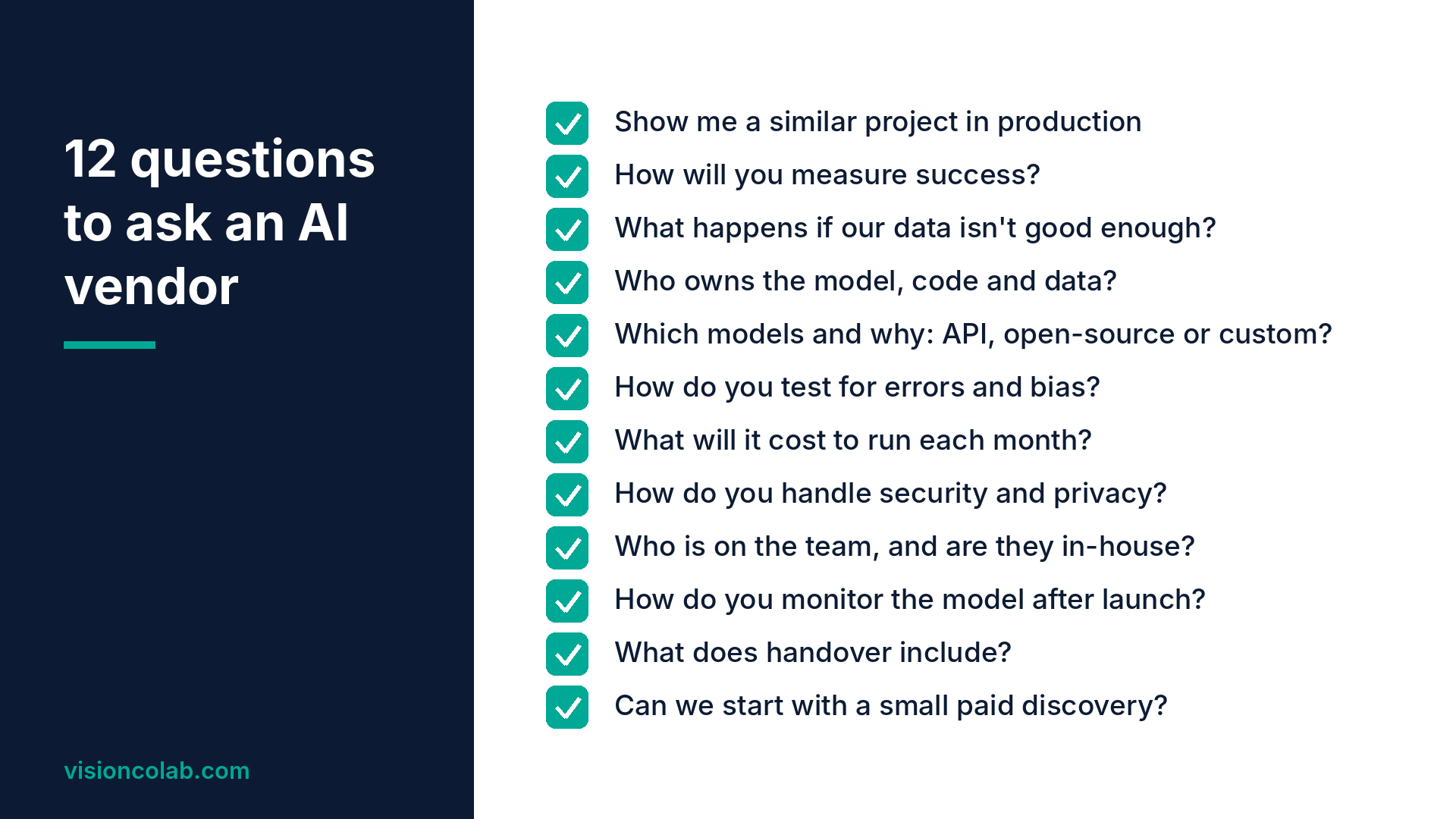
Here are the twelve questions we’d ask if we were hiring an AI partner ourselves, grouped by what they protect you from.
Questions about experience
1. Can you show me something similar that’s in production?
Not a prototype, not a hackathon project. Ask what it does, how many people use it, and what broke after launch. A team that has run AI in production will have stories about data drift, angry users and a model that quietly got worse. A team that hasn’t will talk only about accuracy on a test set.
2. Who exactly will work on our project?
Senior people often run the sales call and then disappear. Ask for names and roles, whether they’re employees or subcontractors, and how much of their week your project gets. You want at least one person who understands machine learning deeply and one who understands software engineering deeply. They’re rarely the same person.
Questions about data and success
3. How will we measure success?
“Better customer experience” is not a metric. “Resolve 40% of tier-one support tickets without a human, with fewer than 2% escalated complaints” is. If a vendor won’t commit to a number, or to how it’s measured, you can’t tell later whether the project worked.
4. What happens if our data isn’t good enough?
This is our favourite question because the honest answer is uncomfortable. Many AI projects stall because the data is thinner, dirtier or more biased than anyone admitted. A good partner checks the data in the first few weeks and tells you plainly if the idea needs more data, a smaller scope or a different approach. Be wary of anyone who promises results before seeing a sample.
5. How do you test for errors and bias?
Ask to see an evaluation plan: the test set, how it was built, which failure cases they check, and who reviews the results. For language models this should include tests for wrong answers stated confidently. For vision or scoring models it should include checks across different groups of users or conditions, not just one overall accuracy figure.
Questions about technology and cost
6. Which models will you use, and why?
There are three broad routes: call a commercial model through an API, run an open-weight model yourself, or train something custom. Each trades off cost, privacy, speed and control. The right vendor explains why their choice fits your case and how hard it would be to switch later. If they only ever use one route, that’s a habit, not a recommendation.
7. What will it cost to run each month?
Build cost gets all the attention. Running cost is what you live with. API usage, GPU hosting, vector databases, monitoring and retraining all add up, and they grow with usage. Ask for an estimate at today’s volume and at ten times that. Our guide to generative AI development cost breaks down where the money usually goes.
Questions about ownership and risk
8. Who owns the code, the trained models and the data?
Get it in the contract. You should own the code written for you, the fine-tuned weights or trained models, the prompts, and of course your data. Check whether the vendor plans to reuse your data to improve their own products. That isn’t automatically bad, but you should agree to it knowingly.
9. How do you handle security and privacy?
Where will data be stored and processed? Which third-party model providers will see it, and under what terms? How are secrets and access managed? If you work in health, finance or with EU customers, ask how they’ve handled HIPAA, PCI DSS or GDPR on earlier projects, and get specifics.
10. How will you monitor the system after launch?
Models degrade as the world changes. Customers start asking new questions, cameras get replaced, product catalogues grow. Ask what gets logged, which alerts exist, who reviews quality each month and how retraining or prompt updates are released.
11. What does handover include?
Even if you plan a long partnership, plan for the day you don’t need one. Handover should include documentation, the evaluation set, infrastructure as code, a runbook and a few sessions with your team. If the system only works while the vendor is on the call, you’ve rented it, not bought it.
12. Can we start with a small paid discovery?
A one-to-three-week discovery phase costs a fraction of the full build and tells both sides whether the project is feasible. You get a scoped plan, a data assessment and a realistic estimate. If the vendor resists this and pushes for a large fixed contract straight away, ask yourself why.
Red flags worth walking away from
- Guaranteed accuracy figures before anyone has seen your data.
- No mention of running costs, monitoring or retraining.
- Vague answers about who owns the trained model.
- Every problem gets the same solution, usually whatever is fashionable this quarter.
- Case studies with no names, numbers or links you can check.
Frequently asked questions
How long does an AI project usually take?
A focused proof of concept often takes four to eight weeks. A production system with integrations, monitoring and security review is more often three to six months. Anyone quoting much less for a production system is probably leaving something out.
Should we hire an in-house AI team instead?
If AI is core to your product and you’ll be building for years, eventually yes. Many companies start with a partner to prove value quickly, then hire once they know what skills they actually need. A good partner will help you make that transition.
Is offshore AI development risky?
Location matters less than process, communication and contracts. We compare the options honestly in onshore vs nearshore vs offshore development.
Further reading
Talk to an AI team that starts with your data
VisionColab begins every AI engagement with a short discovery phase so you know what’s feasible before you commit. See our AI development services or book a free consultation.
Written by the VisionColab team
VisionColab designs and builds AI, web, mobile and cloud software for businesses. Our guides explain the decisions, costs and trade-offs involved in planning a software project.